Sunday, August 30, 2020
Our Famous Teachers Around the First Century BCE; The Tannaim
Nadene Goldfoot
 Rabbi Hillel, the Elder, was a first century BCE scholar who founded the school known as THE HOUSE OF HILLEL or Bet Hillel, and he became an ancestor of a dynasty of patriarchs who held office until the 5th century. Hillel was a scholar associated with the development of the Mishnah and the Talmud. He was born in Babylonia but settled in Judah and earned a slender living by doing manual labor while studying with 2 of the most famous teachers, Shemaiah and Avtalyon. He became president of the Sanhedrin and with his opponent, Shammai, who were the last of the pairs (Zugot) of scholars. He was noted for his humility and leniency in the law. Legal practice ultimately went in almost all cases according to the decision of he House of Hillel. He is known for the Golden Rule: "What is hateful to you, do not do to your fellow: this is the whole Torah; the rest is the explanation; go and learn." Hillel is remembered by college students with their Hillel House Fraternity on college campuses, and in many other ways as well.

Rabbi Shammai, the opposition partner of Hillel, and they lived during the troubled times of Herod's reign (73 BCE-4 BCE). Shammai was a Jewish scholar of the 1st century, and an important figure in Judaism's core work of rabbinic literature, the Mishnah. Shammai was the most eminent contemporary of Hillel. His teachings mostly agree with those of Hillel.
He foresaw the dangers of Roman hegemony and so enacted many rules intended to keep Jews from mixing with the heathen. Shammai took a rigorous point of view in moral and religious matters, and at the same time being of a friendly nature, taught to "receive everyone graciously". His motto was: "Make your study of the Torah a permanent endeavour; speak little, but accomplish much; and receive every man with a cheerful disposition". He was modest even toward his pupils. Although the School of Shammai is famous for its disputes with the School of Hillel, Shammai himself differed on only 3 points with Hillel. Very few halakhic teachings have survived in his name. Shammai is possibly identical with the Pharisee, Sameas, who rallied the Sanhedrin against Herod's attempt at intimidation in 47 BCE.
At the turn of the 1st century, we come into contact with Rabbi Ben Joseph Akiva who lived about from 50 to 135 CE. He was a Tanna. This was a very humble man who remained uneducated until he was 40 years old when his wife, Rachel, who was a daughter of the rich Kalba Sabbus, helped him to devote himself to learn. He studied with many of the best scholars of the period and developed his own method of biblical interpretation according to which every word and sign in the Bible has a particular significance and can be used to establish a source for accepted halakhic decisions. Rabbi Akiva was a leading contributor to the Mishnah and to Midrash halakha. He is also sometimes credited with redacting Abraham's version of the Sefer Yetzirah, one of the central texts of Jewish mysticism. He is referred to in the Talmud as Rosh la-Hakhamim "Chief of the Sages."
Akiva became noted as the greatest scholar of his time and thousands of students studied at his school in Bene Berak in Jerusalem. His interest in mystical speculation is reflected in that he was only one of 4 rabbis who studied this and remained unscathed, becoming a Tanna. A tanna was a teacher living during the 1st 2 centuries CE. The Tannaitic Period began with the death of Hillel and Shammai and ends with the generation after Rabbi Judah Ha-Nasi.
An outbreak of plague among the pupils of Rabbi Akiva in the 2nd century ended on Iyyar 18. This happened this year on the 12th of May. Next year it falls on the 30th of April. It is hence considered the "scholars' feast," the Omer period's regulations for half-mourning which has the prohibitions of marriage, cutting the hair, etc) being suspended. Schoolchildren are given a holiday and formerly used to have mock-battles with bow and arrows.
Rome came out with an edict saying it was prohibited to study the Law of Moses, and Akiva ignored it. The result was that he was arrested as a rebel and had to serve a long prison sentence before being executed at Caesarea. No rabbi of the talmudic period made a more profound impression on Jewish history and on the imagination of the Jewish people.

Rabbi Judah ha-Nasi or Judah I or Judah, the Prince, was a second-century rabbi and chief redactor and editor of the Mishnah. He lived from approximately 135 to 217 CE. He was a key leader of the Jewish community during the Roman occupation of Judea. He was one of Bar Kokhba's supporters and said he was the King-messiah. General Bar Kokhba fought a 3 year war with Rome after he took over Jerusalem in 132 CE. He was killed in 135 CE.
During a famine, Judah opened his granaries and distributed corn among the needy. But he denied himself the pleasures procurable by wealth, saying: "Whoever chooses the delights of this world will be deprived of the delights of the next world; whoever renounces the former will receive the latter."
Such was the man who made such an impression on his student, Rabbi Simeon ben Yohai of the 2nd century, also a Tanna, who came to create the Zohar with his colleagues and disciples. Moses de Leon was also thought to be the author of the The Zohar is their chief work of the Spanish Kabbalah, something like commentaries on sections of the Pentateuch and parts of the Hagiographa (Song of Songs, Ruth, Lamentations). One group of writers, based in Gerona, was inspired by Isaac the Blind while the other, a more elite gathering, was led by Nachmanides and centered in Barcelona. The Kabbalah was the mystical religious stream in Judaism, originally denoting the oral tradition , but by the 12th century was adopted by mystics to denote the alleged continuity of their mystical "tradition" from early times. They discuss the mysteries of the Torah in a kabbalistic spirit. It's made up of lengthy homiletic passages, like medieval exegesis, alternating with short discourses and parables. The 2 earliest parts were composed between 1280 and 1285 in Spain, and the 3rd between 1290 and 1300 by another kabbalist who knew the Zohar and tried to imitate it. It was first printed in 1558-60 and has been reprinted about 80 times. An English translation came out in 1931-1934.
Akiva's pupil, Simeon Bar Yochai, even followed Akiva after Akiva's imprisonment by the Romans. He was expressing opinions which the authorities thought were rebellious and was forced to go into hiding in a cave with his son, Eleazar for 13 years!
He was unworldy, teaching that Torah study should take precedence over the pursuit of a livelihood; even regarding a man who paused in his study to admire nature as deserving death. My comment is that this was going way too far. Today we know that this is not healthy, mentally or physically.
Simeon became a noted miracle-worker. In later life, he was sent on a mission to Rome where he succeeded in obtaining the withdrawal of a persecutory decree.
While he is attributed authorship of the Zohar by many kabbalists, the authenticity of this claim has been challenged by both secular and religious scholars. who point to Moses de León as the author who published the Zohar in the 13th century.
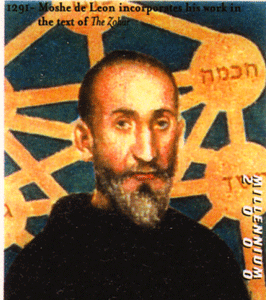
Rabbi Moses de Leon (1250-1305) was a contributor to the Spanish Kabbalah later. He lived in Guadalajara until moving to Avila in 1290, and wrote some 20 kabbalistic works of which only 2 have been printed. His chief fame lied in his revelation of the Zohar, attributed to Rabbi Simeon ben Yohai.
"Hear, my son, the instruction of your father and don't forsake the teaching of your mother (Mishlei 1:8). Get into the habit of always speaking calmly to everyone. This will prevent you from anger, a serious character flaw which causes people to sin. ... Once you have distanced yourself from anger, the quality of humility will enter your heart. This radiant quality is the finest of all admirable traits ... so that you will succeed in all your ways. Thus you will succeed and merit the World to Come which lies hidden away for the righteous.
The book, Zohar, was sent by Nahmanides from Judah to Spain, where it reached the hands of Moses de Leon.
He had an intense love for the Holy Land and considered emigration from there a grievous sin. His pupil, Rabbi Judah Ha-Nasi, frequently quoted him in the Mishnah .

It is said that once Rabbi Judah Ha Nasi saw a calf being led to the slaughtering-block, which looked at him with tearful eyes, as if seeking protection. He said to it: "Go; for you were created for this purpose!" Due to this unkind attitude toward the suffering animal, he was punished with years of illness.


 |
| What would Shammai say? |
He foresaw the dangers of Roman hegemony and so enacted many rules intended to keep Jews from mixing with the heathen. Shammai took a rigorous point of view in moral and religious matters, and at the same time being of a friendly nature, taught to "receive everyone graciously". His motto was: "Make your study of the Torah a permanent endeavour; speak little, but accomplish much; and receive every man with a cheerful disposition". He was modest even toward his pupils. Although the School of Shammai is famous for its disputes with the School of Hillel, Shammai himself differed on only 3 points with Hillel. Very few halakhic teachings have survived in his name. Shammai is possibly identical with the Pharisee, Sameas, who rallied the Sanhedrin against Herod's attempt at intimidation in 47 BCE.
 |
| Born 50 CE , Caesarea, Israel; Died 135 CE Caesarea, Israel |
Akiva became noted as the greatest scholar of his time and thousands of students studied at his school in Bene Berak in Jerusalem. His interest in mystical speculation is reflected in that he was only one of 4 rabbis who studied this and remained unscathed, becoming a Tanna. A tanna was a teacher living during the 1st 2 centuries CE. The Tannaitic Period began with the death of Hillel and Shammai and ends with the generation after Rabbi Judah Ha-Nasi.
An outbreak of plague among the pupils of Rabbi Akiva in the 2nd century ended on Iyyar 18. This happened this year on the 12th of May. Next year it falls on the 30th of April. It is hence considered the "scholars' feast," the Omer period's regulations for half-mourning which has the prohibitions of marriage, cutting the hair, etc) being suspended. Schoolchildren are given a holiday and formerly used to have mock-battles with bow and arrows.
Rome came out with an edict saying it was prohibited to study the Law of Moses, and Akiva ignored it. The result was that he was arrested as a rebel and had to serve a long prison sentence before being executed at Caesarea. No rabbi of the talmudic period made a more profound impression on Jewish history and on the imagination of the Jewish people.
On that Yom Kippur day one of the greatest sages in Jewish history was taken by his Roman captors and put to a torturous death. He had been imprisoned for siding with those opposed to Roman rule. Now he was to be killed. His skin was scraped from his body with iron combs. Yet, not even the harsh Romans could sway him from his faith. As tradition relates, the words of Shema Yisrael were on Rabbi Akiva's lips as he expired.

The grave of Rabbi Akiva is on a hill in Tiberias overlooking the Kinneret. There are many Jewish laws concerning what prayer is permissible to utter at a grave. It is forbidden, for example, to pray to the deceased. There is, though, one prayer upon which all agree. We can look back at the life of Rabbi Akiva as a model and inspiration for our own lives.
 |
| Rabbi Judah ha-Nasi Born 135 CE Judea, Died 217 CE Sepphoris in GalileeSepphoris or Zippori, in the past called Diocaesaraea and, during the Crusades, le Saforie, is a former village and an archaeological site located in the central Galilee region of Israel, 6 kilometers north-northwest of Nazareth. It lies 286 meters above sea level and overlooks the Beit Netofa Valley. Buried: Bet She'arim National Park, Kiryat Tiv'on, Israel |
Rabbi Judah ha-Nasi or Judah I or Judah, the Prince, was a second-century rabbi and chief redactor and editor of the Mishnah. He lived from approximately 135 to 217 CE. He was a key leader of the Jewish community during the Roman occupation of Judea. He was one of Bar Kokhba's supporters and said he was the King-messiah. General Bar Kokhba fought a 3 year war with Rome after he took over Jerusalem in 132 CE. He was killed in 135 CE.
During a famine, Judah opened his granaries and distributed corn among the needy. But he denied himself the pleasures procurable by wealth, saying: "Whoever chooses the delights of this world will be deprived of the delights of the next world; whoever renounces the former will receive the latter."
 |
| Rabbi Simeon ben Yohai Born in the Galilee of Judah |
Akiva's pupil, Simeon Bar Yochai, even followed Akiva after Akiva's imprisonment by the Romans. He was expressing opinions which the authorities thought were rebellious and was forced to go into hiding in a cave with his son, Eleazar for 13 years!
He was unworldy, teaching that Torah study should take precedence over the pursuit of a livelihood; even regarding a man who paused in his study to admire nature as deserving death. My comment is that this was going way too far. Today we know that this is not healthy, mentally or physically.
Simeon became a noted miracle-worker. In later life, he was sent on a mission to Rome where he succeeded in obtaining the withdrawal of a persecutory decree.
While he is attributed authorship of the Zohar by many kabbalists, the authenticity of this claim has been challenged by both secular and religious scholars. who point to Moses de León as the author who published the Zohar in the 13th century.
 |
The Tomb of Rabbi Shimon Bar Yochai on Mount Meron is one of the most famous tombs of a sage in Israel. It is the second
largest religious site (following the Kotel or Western Wall) in Israel.
Kabbalists have made Simeon ben Yohai's traditional tomb at
Mt Meron a center of pilgrimage, especially on LAG BA-OMER (Iyyar 18) , the traditional date of his death.

In Israel, the day is marked by lighting of bonfires and a mass pilgrimage to the tomb of Meron of Rabbi Simeon ben Yohai, who is said to have died, transmitting his mystical lore, on this day.
He is often quoted, as follows:
|

Rabbi Moses de Leon (1250-1305) was a contributor to the Spanish Kabbalah later. He lived in Guadalajara until moving to Avila in 1290, and wrote some 20 kabbalistic works of which only 2 have been printed. His chief fame lied in his revelation of the Zohar, attributed to Rabbi Simeon ben Yohai.
 |
| Rabbi Moses ben Nahman, commonly known as Nachmanides, and also referred to by the acronym Ramban and by the contemporary nickname Bonastruc ça Porta, was a leading medieval Jewish scholar, Sephardic rabbi, philosopher, physician, kabbalist, and biblical commentator. He was born in 1194, Girona, Spain and died on April 4, 1270, Acre, Israel. Ramban (Moshe ben Nahman Gerondi, was a Catalan rabbi, philosopher, physician, Kabbalist and biblical commentator. He is often called "Nachmanides", a Greek translation of the Hebrew "Ben Nahman", meaning "Son of Nahman". |
Rambam reached the peak of his professional reputation as a doctor when he was appointed to the staff of the court of Saladin as royal physician. He was charged with personally supervising the health of the Grand Vizier Alfadhel, as well as members of the royal family.
|
He had an intense love for the Holy Land and considered emigration from there a grievous sin. His pupil, Rabbi Judah Ha-Nasi, frequently quoted him in the Mishnah .

It is said that once Rabbi Judah Ha Nasi saw a calf being led to the slaughtering-block, which looked at him with tearful eyes, as if seeking protection. He said to it: "Go; for you were created for this purpose!" Due to this unkind attitude toward the suffering animal, he was punished with years of illness.

Later, when his daughter was about to kill a small animal which was in her way, he said to her: "Let it live, for it is written: '[God's] tender mercies are over all his works'." After this demonstration of compassion, his illness ceased. Judah also once said, "One who is ignorant of the Torah should not eat meat." The prayer he prescribed upon eating meat or eggs also indicates an appreciation of animal life: "Blessed be the Lord who has created many souls, in order to support by them the soul of every living being.Rabbi Yehudah HaNasi was the editor of the in its final form. He is referred to as “Rebbi,” Teacher par excellence, and as “Rabbeinu HaKadosh,” our Holy Rabbi.
Resource: The New Standard Jewish Encyclopedia
https://www.myjewishlearning.com/article/kabbalah-in-spain/
https://en.wikipedia.org/wiki/Rabbi_Akiva
https://en.wikipedia.org/wiki/Shimon_bar_Yochai
https://www.jewishvirtuallibrary.org/moses-de-le-oacute-n
http://www.jewishmag.com/107mag/rabbiakiva/rabbiakiva.htm
https://www.myjewishlearning.com/article/kabbalah-in-spain/
https://en.wikipedia.org/wiki/Rabbi_Akiva
https://en.wikipedia.org/wiki/Shimon_bar_Yochai
https://www.jewishvirtuallibrary.org/moses-de-le-oacute-n
http://www.jewishmag.com/107mag/rabbiakiva/rabbiakiva.htm
Labels: Ben Joseph Akiva, Hillel, Judah ha-Nasi, kabbala., Moses de Leon, Rabbi Shimon Ben Yochai, Ramban, Shammai, Simeon ben Yohai


Wednesday, February 14, 2018
Alperovitch: Our Goldfoot Connection to Rabbi Wertheimer of 1658-1724 Germany and Austria
Nadene Goldfoot
Our genealogy connects through Alperovitch somehow. My grandparents were Zlata Jermulowske and Nathan Abraham Goldfus of Lithuania. Alperovitch connects to Wertheimer, and the man of genealogical importance to us was Rabbi Samson Wertheimer 1658-1724.
I found an Alperovitch in Russia. Son of Michael Alperovitch, he was born in 1980 in Russia. He's even made it to Wikipedia. Now he's an American and had attended Georgia Institute of Technology. "Alperovitch was awarded the prestigious Federal 100 Award for his contributions to the U.S. federal information security and was recognized in 2013 and 2015 as one of Washingtonian (magazine)'s Tech Titans for his accomplishments in the field of cyber security."
" In August 2011, as vice president of threat research at McAfee, he published Operation Shady RAT, a report on suspected Chinese intrusions into at least 72 organizations, including defense contractors, businesses worldwide, the United Nations and the International Olympic Committee."
My family has computer geniuses. Is it the genes? Could be.
In the book, "Finding Our Fathers" by Dan Rottenberg: , Alpern says, See Heilprin.
Heilprin says, also: Halpern, Heilbronn, Heilbrunn, Heilperin, Heilbron, Heilbroner, Heilperin,
Heilpern, Heilborn, Halperin, Helpern, Alpron, Galpern, Heilprun, Galperin, Halper, Heilpern.
Heilborn, Halperin, Helpern, Alpron, Galpern, Heilprun, Galperin, Halper, Helpern.
It's a German name derived from the town of Heilbronn in Wurttemberg. All Jews with these
variations are not necessarily related. Many Jews of Austria, Germany and Russia
indisciminately assumed these names when they were ordered to take family names.
However, 4 branches of the Heilprin name have been found. JE encyclopedia has charts
for 3 of the branches. Many Russians claim the 4th branch.
The oldest is Zebulon Heilprin of the 16th century. His son was Moses of Brest-Litovsk and
was the father-in-law of Samuel Edels.
Another branch comes from Lithuanian Rabbi Jehiel Heilprin (1660-1746), a descendant of
Solomon Luria, who traced his genealogy back through RASHI (1040-1105). I lived in Safed,
Israel where his synagogue was built and where he lived.
Another Heilprin branch is also related to the BAAL SHEMTOV, founder of Hasidism.
Biographies are in JE. Most people are from Poland, Russia and Germany. There is an EJ
article on Abraham ben Hayyim of Lublin Poland who died in 1762. He was the grandson of
Isser, whose son married FORTIS. CAJ has a Heilprin family tree. LBI has a Heilbrunn family
tree beginning in 1683. LBIS has notes of a Heilbron family from Posen. CAJ has Halpern
family records.
Relatives found include KATZENELLENBOGEN and others listed in the book. Goldfus
was not there.
JE=Jewish Encyclopedia
EJ=Encyclopedia Judaica
CAJ=Central Archives, Jerusalem
LBI=Leo Beck Institute, NY
LBIS=Leo Beck Institute, Rudolf Simonis collection
RASHI traces back to King David. Rashi was a famous Talmudic rabbi and the most famous
Talmudic commentator of the 11th century France. His is supposed to have descended in the
33rd generation from Johanan ha- Sandalar, who lived in 2nd century Egypt. Johanan was a
great-grandson of Rabbi Gamaliel the Elder, who was in turn the grandson of Hillel the Great,
the sage who lived in Jerusalem during the time of King Herod and Jesus.
Hillel is the scholar who was once asked by a scornful heathen to explain Judaism while stand-
ing on one foot. Hillel replied, "What is hateful to thee, do not unto thy fellow man. This is the
whole law, the rest is mere commentary."
Resource: https://en.wikipedia.org/wiki/Dmitri_Alperovitch
Finding Our Fathers, a guidebook to Jewish Genealogy, by Dan Rottenbergm 1977.
http://www.encyclopedia.com/people/philosophy-and-religion/judaism-biographies/rashi
 |
| Nathan Abraham Goldfus/foot of Telsiai, Lithuania |
 |
| Zlata Jermulowske of Lazdijai, Lithuania |
 |
| Dmitri Alperovitch |
I found an Alperovitch in Russia. Son of Michael Alperovitch, he was born in 1980 in Russia. He's even made it to Wikipedia. Now he's an American and had attended Georgia Institute of Technology. "Alperovitch was awarded the prestigious Federal 100 Award for his contributions to the U.S. federal information security and was recognized in 2013 and 2015 as one of Washingtonian (magazine)'s Tech Titans for his accomplishments in the field of cyber security."
" In August 2011, as vice president of threat research at McAfee, he published Operation Shady RAT, a report on suspected Chinese intrusions into at least 72 organizations, including defense contractors, businesses worldwide, the United Nations and the International Olympic Committee."
My family has computer geniuses. Is it the genes? Could be.
In the book, "Finding Our Fathers" by Dan Rottenberg: , Alpern says, See Heilprin.
Heilprin says, also: Halpern, Heilbronn, Heilbrunn, Heilperin, Heilbron, Heilbroner, Heilperin,
Heilpern, Heilborn, Halperin, Helpern, Alpron, Galpern, Heilprun, Galperin, Halper, Heilpern.
Heilborn, Halperin, Helpern, Alpron, Galpern, Heilprun, Galperin, Halper, Helpern.
It's a German name derived from the town of Heilbronn in Wurttemberg. All Jews with these
variations are not necessarily related. Many Jews of Austria, Germany and Russia
indisciminately assumed these names when they were ordered to take family names.
However, 4 branches of the Heilprin name have been found. JE encyclopedia has charts
for 3 of the branches. Many Russians claim the 4th branch.
The oldest is Zebulon Heilprin of the 16th century. His son was Moses of Brest-Litovsk and
was the father-in-law of Samuel Edels.
Another branch comes from Lithuanian Rabbi Jehiel Heilprin (1660-1746), a descendant of
Solomon Luria, who traced his genealogy back through RASHI (1040-1105). I lived in Safed,
Israel where his synagogue was built and where he lived.
Another Heilprin branch is also related to the BAAL SHEMTOV, founder of Hasidism.
Biographies are in JE. Most people are from Poland, Russia and Germany. There is an EJ
article on Abraham ben Hayyim of Lublin Poland who died in 1762. He was the grandson of
Isser, whose son married FORTIS. CAJ has a Heilprin family tree. LBI has a Heilbrunn family
tree beginning in 1683. LBIS has notes of a Heilbron family from Posen. CAJ has Halpern
family records.
Relatives found include KATZENELLENBOGEN and others listed in the book. Goldfus
was not there.
JE=Jewish Encyclopedia
EJ=Encyclopedia Judaica
CAJ=Central Archives, Jerusalem
LBI=Leo Beck Institute, NY
LBIS=Leo Beck Institute, Rudolf Simonis collection
 |
| RASHI |
RASHI traces back to King David. Rashi was a famous Talmudic rabbi and the most famous
Talmudic commentator of the 11th century France. His is supposed to have descended in the
33rd generation from Johanan ha- Sandalar, who lived in 2nd century Egypt. Johanan was a
great-grandson of Rabbi Gamaliel the Elder, who was in turn the grandson of Hillel the Great,
the sage who lived in Jerusalem during the time of King Herod and Jesus.
 |
| Hillel of 1st century BCE |
Hillel is the scholar who was once asked by a scornful heathen to explain Judaism while stand-
ing on one foot. Hillel replied, "What is hateful to thee, do not unto thy fellow man. This is the
whole law, the rest is mere commentary."
Resource: https://en.wikipedia.org/wiki/Dmitri_Alperovitch
Finding Our Fathers, a guidebook to Jewish Genealogy, by Dan Rottenbergm 1977.
http://www.encyclopedia.com/people/philosophy-and-religion/judaism-biographies/rashi
Labels: Austria, Dmitri Alperovitch, Finding Our Fathers, Germany, Hillel, Lihuania, Rashi, Samson Wetheimer, Zebulon Heilprin
Thursday, March 24, 2016
DNA Connecting Goldfoot to Rashi-How Rashi Connects to King David with Descendants such as Karl Marx
Nadene Goldfoot

Many Jews can claim a connection to Rashi, the famous biblical commentator (1040-1105).
 We've had the discovery that our DNA connects to Rabbi Samson Wertheimer or his brother (1658-1724) who was born in Worms, Germany. He in turn connects to Rashi who is descended from King David.
Worms turned out to be a center of rabbis who studied and debated together. Jews had lived in this town since the 10th century, which was in the 900s. Emperor Henry IV in the 11th century, in return for financial assistance, rewarded the Jews with privileges of living there in 1074 and 1090 by granting them freedom of commerce, security of property, and imperial protection. But...the community was completely destroyed in the FIRST CRUSADE. After being reestablished it was again destroyed in the BLACK DEATH OUTBREAKS of 1349. They were expulsed in 1615! Restrictions were imposed on Jews in 1641, just before Wertheimer's birth. They saw the massacre of Jews by the soldiers of Louis XIV in 1689. He had gone to Vienna in 1684 to join the bank of his uncle, Samuel Oppenheimer, and soon became a court banker. Wertheimer was a relative of Rashi, the famous biblical commentator whose comments are found in the Talmud and Rashi descended from King David. In 1933, there were 1,200 Jews living here, but all life ended with the Nazis.
Rashi, an abbreviation for Rabbi Solomon Yitzhaki, which means Ben Isaac-the son of Isaac, was born February 22, 1040 and died July 13, 1105, in Troyes, France. He studied in the Rhineland (Germany) and established a school in Troyes. He made a living from his vineyard. His commentaries were used as the basis for later scholars such as Nahmanides and Ibn Ezra in how they interpreted the Torah-both written and oral law (Pentateuch refers to -written law only).
When the Temple in Jerusalem was destroyed by the Romans in 70 CE, Jews fled. One group went from there to Rome, and from Rome to France.
King David lived from about 1043 BC to 973 BCE. A descendant was Hillel, The Great who lived from 70 BCE to about 10 CE. His descendant was Simeon Ha-Nasi. The next descendant was Rabbi Gamliel, the Elder (early 1st century who was President of the Sanhedrin at Jerusalem and grandson of Hillel. He brought about the betterment of the legal position of women. Christians say he was the teacher of Paul Three generations later we find Hohanan Ha-Sandalar of Egypt living in the 2nd century CE. His descendants were Joshua, Jochanan, Nachman, Jose, who was the author of Luleiot Hashor, Yanai, Rabbi Mananaigaon, Rabbi Jose of Constantinople, Ha-Gaon Rabbi Abraham, Rabbi Aaron-a renowned doctor,
and Ha-Gaon Rabbi Eliakim. This carries the family to 20 later generations of Rashi.
Finally we get to Solomon, Isaac, and then Solomon (Rashi of Troyes, France (1040-1105). Isaac and his wife, Abun, had a daughter who gave birth to Rashi. Isaac's son was Simon the Elder. Rashi's descendants were Isaac (Ribam) who left 7 children: of which Samuel Spira begat Solomon Spira in the 14th century which led to the Luria family, the Meir Katzenellenbogen family, the Jehiel Heilprin family, etc. Samuel Spira had a daughter who married into her relative's family, Abraham Treves who died after 1384. The Treves family were followed by the Dreyfus family.
Rashi had another daughter, Mirium, who married Judah ben Nathan. Their descendants were YomTov (YomTov Ben Isaac of Joigny, France who died in 1190 in York, England and was a tosaphist and liturgical poet. He died in the York massacre on the Sabbath before Passover, March 16, 1190, when the Jews were headed by YomTov and were besieged in the Castle Keep by a bloodthirsty mob and killed one another rather than surrender. This rabbi wrote the hymns used for the eve of the Day of Atonement. His descendants continued the line with Judah, Isaac, and down to Judah Sir Leon of Paris (1166-1224). His descendants were Rabbi Joseph Treves of Marseilles, France in the 14th century, Mattithiah Treves of Provence (1325-1387), and his sons were: Abraham Treves who died after 1384 and had been married to cousin Samuel Spira's daughter. Also, 2 more sons were Johanan Treves who died in 1439 and Joseph Treves of Paris who died in 1429.
 The most famous of the Luria family was Isaac ben Solomon, Rabbi, known as "Ashkenazi" (Ari-the Lion) (1534-1572), a Palestinian kabbalist. He was born in 1534, in Jerusalem, Palestine, Ottoman Empire—died August 5, 1572, in Safed, Syria [now Zefat, Israel]), eponymous founder of the Lurianic school of Kabbala (Jewish esoteric mysticism). (note: We Jews were now living in our own country that had been renamed by the Romans to Palestine, so now all our relatives were Palestinians). This didn't change until May 14, 1948, when Israel was rebirthed ). It is also said that both his parents were Germans, so that's why he would have been called the Ashkenazi. He was educated in Egypt. He lived in Safed (the city I lived in for 4+ years) from 1570 till death 2 years later. "Luria’s father was an Ashkenazi (a German or Polish Jew) who died when Isaac was very young, while his mother was a Sephardi (of Iberian-North African Jewish stock) with family in Egypt. .they went to Egypt after his father's death, which would have been in 1540. . Isaac's mother's brother was " Mordecai Frances, a wealthy tax-farmer. As a child, Luria was described as a young genius, “a Torah scholar who could silence all opponents by the power of his arguments,” and also as possessed of divine inspiration."
This famous man became renowned for his ascetic life and saintly character. His identification of ancient graves in the Galilee conferred on them sanctity which has persisted to the present day among the Orthodox. His teachings received by his disciples orally, were posthumously recorded by his pupil, Hayyim Vital. Luria's teaching deeply influenced subsequent mystical thought. Luria's personality was the subject of many legends. He had launched a neo-kabbalistic movement which had a big impact on Jewish life, especially in the Mediterranean area and in Europe. "Luria died in an epidemic in the summer of 1572 and was buried in Safed."
Solomon "Shlomo" ben Jehiel Luria was known as the Maharshal (1510-1573) in Brest-Litovak, Lithuania was also a rabbi and codifier who officiated in several Lithuanian and Polish communities such as Lublin. His ideas showed his independent and he gave critical views which made him many opponents, but the greatness of his learning was undisputed. He had criticized the Shulhan Arukh for relying on codifiers instead of going to the source-the Talmud, which he regarded as the sole halakhic authority. He was one of the greatest Polish Talmudists. His family had migrated from Germany to Poland and had sent the young boy to the Yeshivah of Lublin, where he studied together with the famous ReMO, Rabbi Moshe Isserles, under Rabbi Shalom Shacne, the founder of this first Talmudical academy in Poland. His line going back to his father was Jehiel Luria, then to Abraham who goes back to Jehiel Luria who died 1470 (we name after deceased relatives), then to Aharon, then Nathanial, Jehiel, and Solomon Spira of the 14th century and descendant of Rashi whose daughter, Miriam had married Samson Luria.
 Karl Heinrich Marx was a German social philosopher with Jewish parents in Prussia, but they had abandoned Judaism before his birth and had him baptized (entering into Christianity) at the age of 6. Their town of Trier "Treves" had been under the authority of the Bishop until 1794. In 1096, the Jews suffered martyrdom or became converted. Many would return to Judaism 5 years later. The Jews here rose to importance in the 13th century which culminated in the elevation of individuals to positions in the 14th century which was unparalleled in Germany. During the Black Plague of 1349, the Jewish community was destroyed. After the Jews returned in the 1350's, they were expelled again in 1418, and then returned again in 1500. They were regarded as a juridical unit and would receive charters for usually 12 years at a time. In 1933, 800 Jews were living in Trier. By 1990, there were a few dozen.
Karl's assumption of Marxism was that history was essentially the account of class struggles between the oppressing and the oppressed. He had no expert knowledge of any Jewish problems because he studied none of them. His attitude towards Jews was with antipathy and contempt. He described Judaism and the Jews like those used by anti-Semites. From 1848, his idea of Jews that lasted was as a financial reactionary group only. This is what happened by leaving Judaism. It shows that our character is not all in the genes, but also what we learn. That's why we were given the 10 Commandments-to learn the ethics we follow. That wasn't enough. Then we were given 613 more laws to be followed-the same number as we have bones in our body. Judaism hasn't had many converts, but we've had some.
 King David was the great grandson of Ruth, the Moabite, a convert to Judaism and beloved by Jews. Her first husband, Mahlon, a Jew, died, and then she went to live with her mother-in-law, Naomi, who was Jewish. They returned to Bethlehem where she remarried Boaz, a kinsman of Naomi's. Hence, Ruth's son was Oved, and Oved had Jesse, and Jesse's son was David. Out of the past 6 ancestors, one was not Jewish, so he was 5/6th Jewish by DNA and one part Moabite. Moab was the country of Southern Transjordan, kindred to the Israelites and descended from Lot, Abraham's nephew. They spoke the language that was the same as biblical Hebrew. This heritage didn't affect David one bit-more to the betterment of his character.
The New Standard Jewish Encyclopedia
Finding Our Fathers-a guidebook to Jewish genealogy by Dan Rottenberg
Dr. Jeffrey Mark Paull's paper: The Y-DNA Genetic Signature and Ethnic Origin of the Katzenellenbogen Rabbinical Lineage
http://www.chabad.org/library/article_cdo/aid/112518/jewish/Rabbi-Shlomo-Luria.htm
http://www.britannica.com/biography/Isaac-ben-Solomon-Luria
https://www.jewishvirtuallibrary.org/jsource/biography/Luria.html
http://www.eilatgordinlevitan.com/kurenets/k_pages/luria.html pictures and list of Luria members
https://en.wikipedia.org/wiki/Isaac_Luria

Many Jews can claim a connection to Rashi, the famous biblical commentator (1040-1105).

Worms turned out to be a center of rabbis who studied and debated together. Jews had lived in this town since the 10th century, which was in the 900s. Emperor Henry IV in the 11th century, in return for financial assistance, rewarded the Jews with privileges of living there in 1074 and 1090 by granting them freedom of commerce, security of property, and imperial protection. But...the community was completely destroyed in the FIRST CRUSADE. After being reestablished it was again destroyed in the BLACK DEATH OUTBREAKS of 1349. They were expulsed in 1615! Restrictions were imposed on Jews in 1641, just before Wertheimer's birth. They saw the massacre of Jews by the soldiers of Louis XIV in 1689. He had gone to Vienna in 1684 to join the bank of his uncle, Samuel Oppenheimer, and soon became a court banker. Wertheimer was a relative of Rashi, the famous biblical commentator whose comments are found in the Talmud and Rashi descended from King David. In 1933, there were 1,200 Jews living here, but all life ended with the Nazis.
Rashi, an abbreviation for Rabbi Solomon Yitzhaki, which means Ben Isaac-the son of Isaac, was born February 22, 1040 and died July 13, 1105, in Troyes, France. He studied in the Rhineland (Germany) and established a school in Troyes. He made a living from his vineyard. His commentaries were used as the basis for later scholars such as Nahmanides and Ibn Ezra in how they interpreted the Torah-both written and oral law (Pentateuch refers to -written law only).
When the Temple in Jerusalem was destroyed by the Romans in 70 CE, Jews fled. One group went from there to Rome, and from Rome to France.
 |
| Hillel-1st century BCE, founder of the House of Hillel born in Babylonia Settled in Palestine and did manual labor while a student with the famous Shemaiah and Avtalyon, became president of Sanhedrin, known for his humility and leniency. |
and Ha-Gaon Rabbi Eliakim. This carries the family to 20 later generations of Rashi.
Finally we get to Solomon, Isaac, and then Solomon (Rashi of Troyes, France (1040-1105). Isaac and his wife, Abun, had a daughter who gave birth to Rashi. Isaac's son was Simon the Elder. Rashi's descendants were Isaac (Ribam) who left 7 children: of which Samuel Spira begat Solomon Spira in the 14th century which led to the Luria family, the Meir Katzenellenbogen family, the Jehiel Heilprin family, etc. Samuel Spira had a daughter who married into her relative's family, Abraham Treves who died after 1384. The Treves family were followed by the Dreyfus family.
Rashi had another daughter, Mirium, who married Judah ben Nathan. Their descendants were YomTov (YomTov Ben Isaac of Joigny, France who died in 1190 in York, England and was a tosaphist and liturgical poet. He died in the York massacre on the Sabbath before Passover, March 16, 1190, when the Jews were headed by YomTov and were besieged in the Castle Keep by a bloodthirsty mob and killed one another rather than surrender. This rabbi wrote the hymns used for the eve of the Day of Atonement. His descendants continued the line with Judah, Isaac, and down to Judah Sir Leon of Paris (1166-1224). His descendants were Rabbi Joseph Treves of Marseilles, France in the 14th century, Mattithiah Treves of Provence (1325-1387), and his sons were: Abraham Treves who died after 1384 and had been married to cousin Samuel Spira's daughter. Also, 2 more sons were Johanan Treves who died in 1439 and Joseph Treves of Paris who died in 1429.
 |
| Rabbi Isaac ben Solomon Luria A book about him is Window of the Soul: The Kabbalah of Rabbi Isaac Luria, 1534-1572 : Selections from Chayyim Vital, More |
Solomon "Shlomo" ben Jehiel Luria was known as the Maharshal (1510-1573) in Brest-Litovak, Lithuania was also a rabbi and codifier who officiated in several Lithuanian and Polish communities such as Lublin. His ideas showed his independent and he gave critical views which made him many opponents, but the greatness of his learning was undisputed. He had criticized the Shulhan Arukh for relying on codifiers instead of going to the source-the Talmud, which he regarded as the sole halakhic authority. He was one of the greatest Polish Talmudists. His family had migrated from Germany to Poland and had sent the young boy to the Yeshivah of Lublin, where he studied together with the famous ReMO, Rabbi Moshe Isserles, under Rabbi Shalom Shacne, the founder of this first Talmudical academy in Poland. His line going back to his father was Jehiel Luria, then to Abraham who goes back to Jehiel Luria who died 1470 (we name after deceased relatives), then to Aharon, then Nathanial, Jehiel, and Solomon Spira of the 14th century and descendant of Rashi whose daughter, Miriam had married Samson Luria.
Of the Luria family descent, remember Solomon Spira who had a daughter, Miriam who married Sampson Luria of the 14th century. Their descendants were Jehiel, Nathaniel and Aharon Luria. A descendant was Jehiel Luria who died in 1470, Abraham, Jehiel, and Solomon Luria (1510-1571) born in Lublin, died in Brest-Litovesk, Poland 1470. . The next generation was Zeev Wolf Luria and Miriam who married Eliezer Isserles.
The Luria family is related to the Kalonymus family of Italy of which I find our family has connections.
This continues, but I'm going to skip down to Abraham Luria, son of Jehiel Luria ancestor of the Maharashal (1510-1573). Jehiel Luria had a daughter who married Isaac Katzenellenbogan. Their ancestors were Meir Katzenellenbogen of Paduda (1482-1565), Samuel Judah Katzenellenbogen of Padua, Italy (1521-1597), Deborah Drucker who married Saul Wahl of Brest-Litovsk (1541-1617), Hinda Horowitz who married Meir Wahl Katzenellenbogen of Brest-Litovsk, and Nessla who married Moses Cohen of Luck who had a daughter who married Aaron Lvov of Trier (Treves)- a town in Germany where Jews had settled in 1066 that died in 1712 who was the great great great grandfather of KARL MARX (1818-1883) father of Communism. Karl's assumption of Marxism was that history was essentially the account of class struggles between the oppressing and the oppressed. He had no expert knowledge of any Jewish problems because he studied none of them. His attitude towards Jews was with antipathy and contempt. He described Judaism and the Jews like those used by anti-Semites. From 1848, his idea of Jews that lasted was as a financial reactionary group only. This is what happened by leaving Judaism. It shows that our character is not all in the genes, but also what we learn. That's why we were given the 10 Commandments-to learn the ethics we follow. That wasn't enough. Then we were given 613 more laws to be followed-the same number as we have bones in our body. Judaism hasn't had many converts, but we've had some.

The New Standard Jewish Encyclopedia
Finding Our Fathers-a guidebook to Jewish genealogy by Dan Rottenberg
Dr. Jeffrey Mark Paull's paper: The Y-DNA Genetic Signature and Ethnic Origin of the Katzenellenbogen Rabbinical Lineage
http://www.chabad.org/library/article_cdo/aid/112518/jewish/Rabbi-Shlomo-Luria.htm
http://www.britannica.com/biography/Isaac-ben-Solomon-Luria
https://www.jewishvirtuallibrary.org/jsource/biography/Luria.html
http://www.eilatgordinlevitan.com/kurenets/k_pages/luria.html pictures and list of Luria members
https://en.wikipedia.org/wiki/Isaac_Luria
Labels: dna, genealogy, Goldfoot, Hillel, Karl Marx, Katzenellenbogen, King David, Luria, Rabbi Wertheimer, Rashi, Ruth, York massacre
